Mandrel Bends vs Crush Bends: Why Exhaust Fabrication Method Matters
A pipe bend has to change direction without compromising the route. Mandrel-supported bending is intended to maintain the tube's shape and internal area more consistently, while basic compression or crush bending can narrow and distort the bend. The practical value depends on where, how sharply and how often the pipe turns.
What this guide helps you decide
Use this guide to inspect bend quality, ask better fabrication questions and understand why the complete route matters more than a single marketing term.
What happens when a tube bends
The outside of a bend stretches while the inside compresses. Without suitable tooling and support, the cross-section can flatten, the inner radius can wrinkle and the effective area can reduce. Thin walls and tight radii make control more demanding.
Not every visible deformation creates the same consequence, but an abrupt restriction in a high-flow route is undesirable. The fabricator should select bend radius, tooling and wall thickness together.
How mandrel support helps
A mandrel supports the inside of tube during bending, helping preserve roundness through the curve. Appropriate dies and setup remain essential; the word mandrel does not guarantee a flawless bend when material, lubrication or machine configuration is wrong.
Custom exhaust workshops may use pre-formed mandrel bends cut and joined into the route rather than bending every tube in-house. That can still produce controlled geometry when joints are aligned and fabricated properly.
Why reduced area can matter
A flattened bend can become a local restriction, particularly where the nominal pipe size was selected close to the engine's flow requirement. Several poor bends can compound the effect. The impact depends on the complete system, engine and operating range rather than appearance alone.
An oversized pipe with poor bends is not automatically better than a correctly sized route with consistent area. Diameter, bend quality, transitions, silencers and catalysts must be evaluated together.
Routing quality is more than maximum flow
A smooth bend is valuable only when the route also clears the body, suspension and ground. Using the largest available radius may push the pipe below the car or into another component. Fabrication often balances radius, available envelope and joint placement.
A carefully planned sequence can use fewer bends and shorter routing. This may benefit fitment and weight more than choosing an elaborate path merely to display additional welded sections.
Segmented bends have a specific role
Pie-cut or segmented bends can create tight or unusual geometry where ordinary bends do not fit, especially in manifolds and conversions. They add welds and preparation, so their value should come from packaging or collector design rather than visual fashion alone.
Each segment needs accurate fit-up and alignment. A decorative external pattern does not prove the internal steps are smooth or the completed curve follows the intended radius.
Inspect the route, not one bend
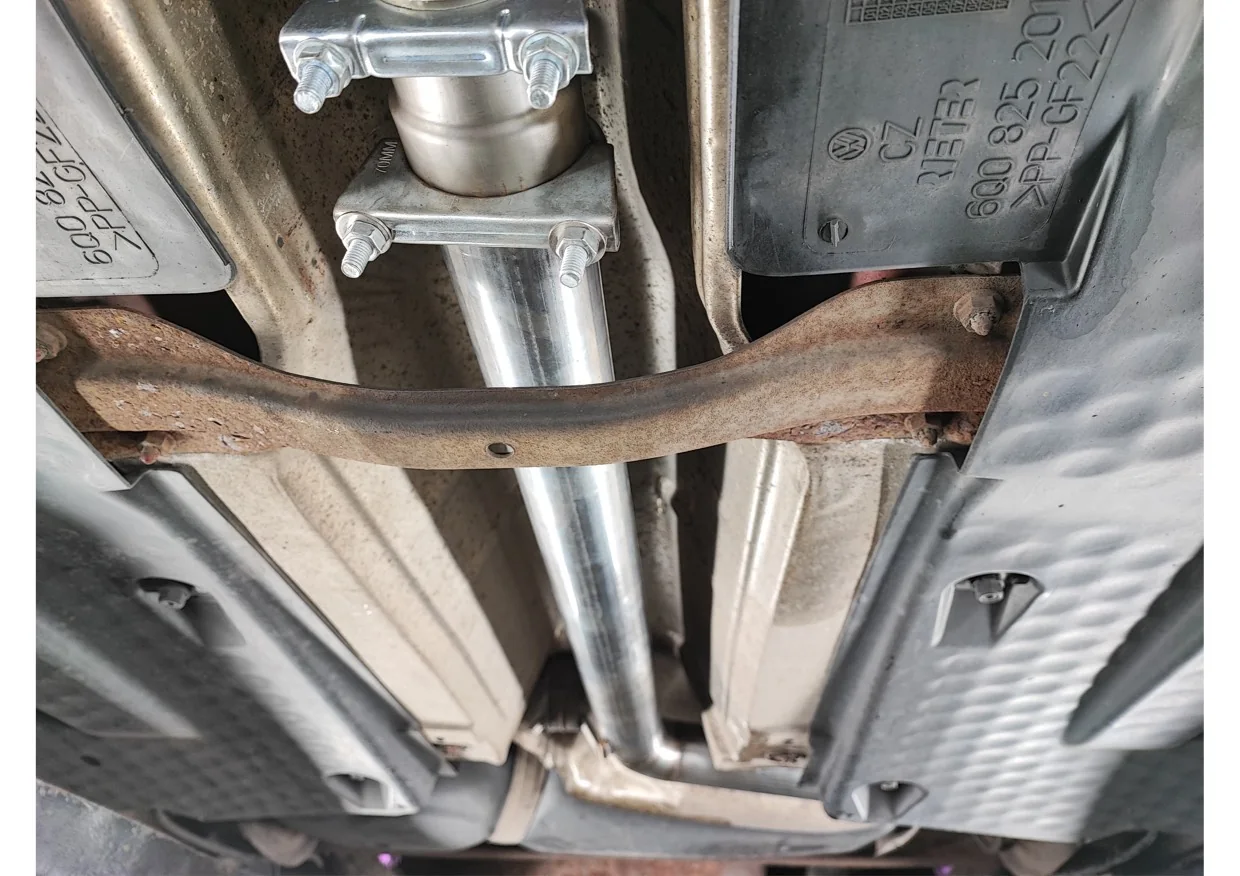
Look for consistent section, sensible radii, clean transitions and joints that do not step into the gas path. Check ground clearance and whether hangers pull the pipe sideways. Ask where the tightest restriction remains after fabrication.
For a quote, identify whether pre-formed bends, machine bending or fabricated segments will be used. The answer should connect to the vehicle's space and objective.
- Maintained internal area
- Appropriate bend radius
- Smooth joint alignment
- Ground and component clearance
- Minimum unnecessary direction changes
Choose fabrication method by outcome
A premium route preserves the required area, fits securely and can be serviced. Mandrel bends are useful because they support those outcomes, not because the term belongs in every product description. A simple repair may not need the same process as a high-output manifold.
Pi Motorsport can explain which bends and transitions are proposed and why. That specificity gives the owner a better basis for comparison than assuming every shiny curved pipe delivers identical flow and durability.
Use a bend-quality checklist at collection
Follow the route from each new joint and look for flattened sections, wrinkles, abrupt diameter changes and unnecessary direction changes. Confirm that bends clear the floor and moving components without hangers pulling them sideways. Where segmented fabrication is used, ask why the available space required it and whether the internal transitions were dressed or aligned as part of the process.
The checklist should not turn customers into weld inspectors; it creates a practical conversation about what they paid for. Ask Pi Motorsport to identify the tightest bend, the narrowest retained component and the method used through the most constrained area. Those three answers connect the headline phrase mandrel bent to real system geometry, fitment and future serviceability.
Compare bend routes using area, radius and joint count
When two layouts are possible, compare the tightest internal area, bend radius, number of welded joints, total direction changes and resulting ground clearance. A route with beautiful mandrel sections can still be inferior if it takes an unnecessary detour, adds several poorly accessible joints or hangs below the chassis. Conversely, one tighter fabricated turn may be reasonable when it preserves the rest of the route and remains properly supported.
Ask the quotation or handover to identify the constrained area that drove the method. For a simple cat-back, that may be an axle or rear subframe; for a manifold, it may be steering and collector placement. Pi Motorsport can then explain the chosen combination of pre-formed bends, machine bends and segments as a packaging decision. Judge the complete route and clearances, not the name of one bending method.
Ask for a view of the tightest bend on the proposed route. Compare the shape at the middle of the bend with the straight tube next to it. A visibly flattened section may change the usable area. Check how the bend lines up with the joints and still clears the underbody as the system moves. The inspection supports a fitment decision, and performance figures require separate measurements.